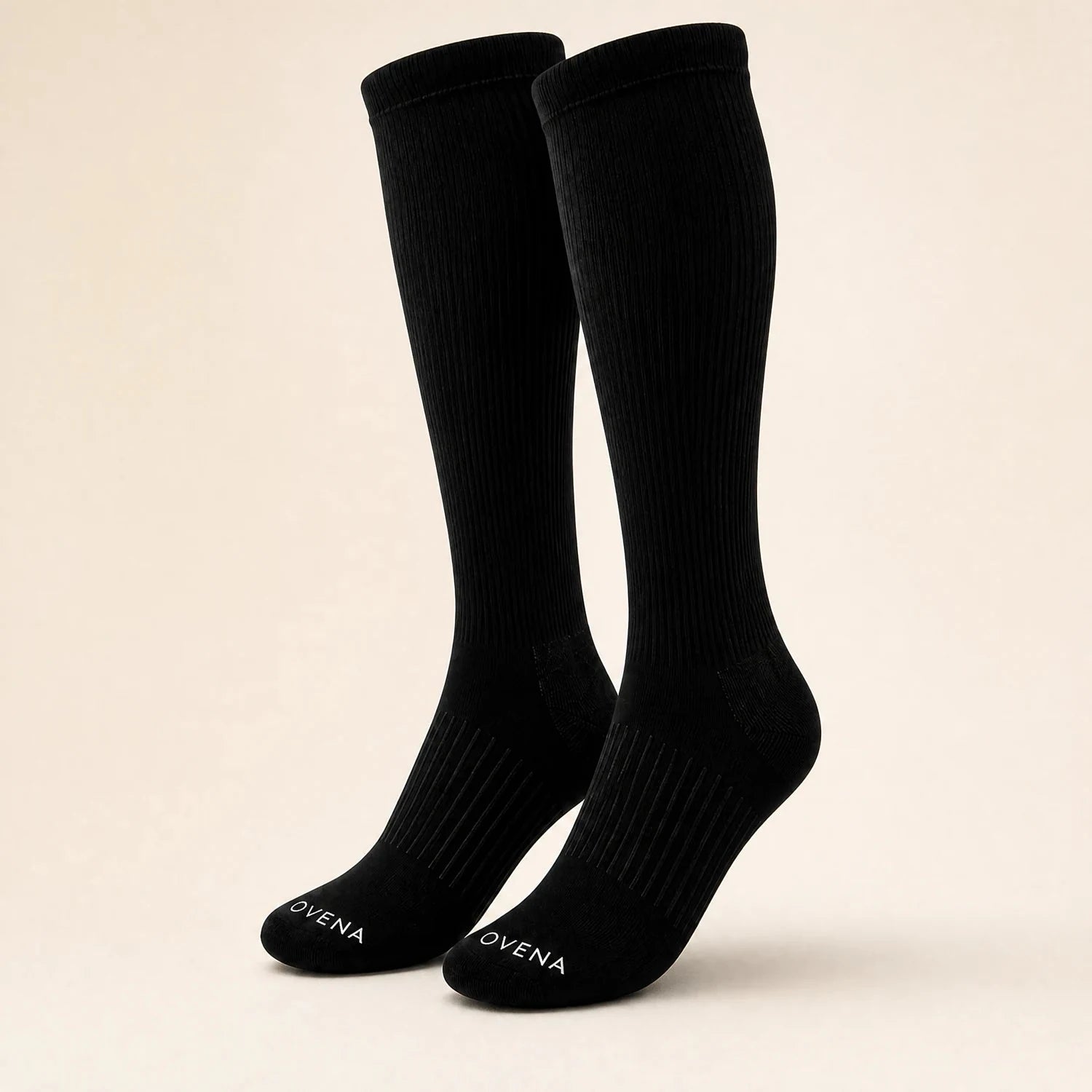
Best compression socks for flying, Cochrane-backed guide
Why graduated compression reduces asymptomatic DVT risk on long flights, what mmHg to choose, when to put them on, and who has elevated risk.
 Reviewed byDavid Chahine, MD
In this guide
Why long flights raise clot risk
The mechanism is stasis — blood that stops moving. Two things about a long flight produce it:
- Immobility. When your calf muscles aren't contracting, the venous "muscle pump" that normally pushes blood back up to your heart stops. Blood pools in the lower legs, and pooled blood is more prone to clot formation.
- Cramped seating. The edge of the seat pressing against the back of the knee can occlude venous return.
Most people fly with no consequence. Some don't. The clinical name for the event is "traveler's thrombosis" or "economy class syndrome." The most-quoted incidence figure comes from a cohort of 8,755 employees of large international companies and organizations, in which the rate worked out to about one venous thrombosis per 4,656 flights of four hours or longer (1, 4). Read it for what it is: a per-flight rate in a working-age, business-travel population, not a lifetime risk for everyone who flies.
What the Cochrane evidence actually says
The most-cited evidence on flight compression is the Cochrane review by Clarke and colleagues, which pooled 12 randomized controlled trials of 2,918 long-distance travelers (2). The headline finding:
What the review also showed:
- No symptomatic DVT, pulmonary embolism, or death occurred in either group. Across 2,821 participants in nine trials there were no such events at all, so the review could not assess whether stockings change them.
- In three of those nine trials, no symptomless DVT turned up in either group.
- Compression also reduced lower-extremity edema, on low-certainty evidence.
Two caveats belong with those numbers. "Symptomless DVT" means clots found on ultrasound that never caused symptoms, and how much preventing those matters compared with the rarer symptomatic events is genuinely debated. And although the review set its threshold at flights of four hours or more, every trial it included studied flights longer than five hours, so it says nothing about a short hop. Guidance bodies land in the same place: compression for travelers who already carry VTE risk factors, not routine compression for everyone who flies (1, 3).
Who needs compression on flights
For long-distance travel, the American College of Chest Physicians suggests properly fitted, below-knee stockings providing 15-30 mmHg of pressure at the ankle for travelers who already have VTE risk factors, and suggests against them for travelers who do not (Grade 2C, a weak suggestion based on low-certainty evidence) (3). The guideline sets no flight-duration threshold: the 4-hour figure comes from the Cochrane trials' inclusion criteria, not from ACCP.
The risk factors that put you in that group:
- Personal or family history of DVT or pulmonary embolism
- Active cancer or chemotherapy
- Recent major surgery (within 3 months), especially orthopedic
- Pregnancy or recent childbirth (within 6 weeks)
- Estrogen-containing oral contraceptive or hormone replacement therapy
- Known hereditary thrombophilia (Factor V Leiden, prothrombin G20210A, etc.)
- Obesity (BMI >30)
- Age >60
- Varicose veins or chronic venous insufficiency
- Lower-extremity injury or cast within the past 3 months
If you have any two or more of these, discuss your personal risk with your clinician before long flights.
What mmHg to wear
If compression is right for you at all, the two classes in play for travel are 15-20 mmHg and 20-30 mmHg.
- 15-20 mmHg. If you're a healthy traveler with none of the risk factors above, the ACCP guideline suggests against compression rather than for it (3). If you want it anyway for comfort or to keep your ankles from puffing on a long sector, this is the easy class to live in: simpler to put on, and unobtrusive in a seat.
- 20-30 mmHg. The class to discuss with your clinician if you do carry the risk factors above, or if ankle swelling on past flights has bothered you. Of the nine included trials that used below-knee stockings, four used 20-30 mmHg at the ankle and five used 10-20 mmHg (2).
Higher classes (30-40 mmHg) are typically not used for flying — they're for chronic venous insufficiency, lymphedema, and post-DVT care, and they're more restrictive than travel calls for.
When to put them on (and take off)
- Put them on before leaving home, before your legs have any chance to swell from sitting in a car, on a train, or at the gate.
- Keep them on through the entire trip — flight, layovers, and any onward car travel.
- Take them off at your destination once you've walked around for an hour or so.
- Don't sleep in compression as a routine. After a very long flight that arrives at night, it's fine to leave them on until morning.
Taking the socks off is not the end of the risk window. In the cohort behind the 1-in-4,656 figure, thrombosis risk was highest in the first two weeks after a long-haul flight and drifted back to baseline by about eight weeks (4). That is why the red flags below run for weeks rather than hours.
What else helps (and what's marketing)
Actually helps
- Walk the aisle every 1-2 hours if you can. Calf-muscle contractions push pooled blood out.
- Ankle pumps in your seat — flex and point your toes 10-15 times every 30 minutes. That works the calf muscle pump while you stay seated.
- An aisle seat, which makes getting up easier.
Mostly marketing
- "Anti-clot" supplements sold for travel (garlic, vitamin E, and the like) — no robust evidence.
- Aspirin "just before flying." For low-risk travelers, the evidence doesn't support routine aspirin to reduce travel-related clot risk. Discuss it with your doctor.
- "Anti-DVT inflatable cushions" — most haven't been studied. Compression is the intervention with trial evidence behind it.
- "Drink water so your blood doesn't thicken." Staying hydrated is a fine idea for how you feel, but the UK guideline authors state flatly that there is no evidence of an association between dehydration and travel-associated clots (1). Sitting still is the mechanism that matters.
Red flags during and after a flight
- Persistent calf or thigh pain, especially one-sided, deep, or worse with flexion
- Unilateral leg swelling (one leg noticeably larger than the other)
- Warmth, redness, or visible vein prominence in one calf
- Shortness of breath, chest pain, or coughing up blood — possible pulmonary embolism. Go to the emergency department immediately.
20-30 mmHg compression for travel
Ovena's 20-30 mmHg knee-high graduated compression, in sizes S-XL. Start with one pair. Free shipping over $75.
Shop compression socks →Frequently asked questions
How long does a flight need to be to warrant compression?
What about during the entire trip, not just the flight?
Will they really lower my DVT risk?
What about the small fold-up TSA-friendly ones?
Sources
- Watson HG, Baglin TP. Guidelines on travel-related venous thrombosis. Br J Haematol. 2011;152(1):31-34.
- Clarke MJ, Broderick C, Hopewell S, Juszczak E, Eisinga A. Compression stockings for preventing deep vein thrombosis in airline passengers. Cochrane Database of Systematic Reviews 2021, Issue 4. Art. No.: CD004002. https://doi.org/10.1002/14651858.CD004002.pub4
- Kahn SR, Lim W, Dunn AS, et al. Prevention of VTE in Nonsurgical Patients: Antithrombotic Therapy and Prevention of Thrombosis, 9th ed: American College of Chest Physicians Evidence-Based Clinical Practice Guidelines. Chest. 2012;141(2 Suppl):e195S-e226S. https://doi.org/10.1378/chest.11-2296
- Kuipers S, Cannegieter SC, Middeldorp S, Robyn L, Buller HR, Rosendaal FR. The absolute risk of venous thrombosis after air travel: a cohort study of 8,755 employees of international organisations. PLoS Med. 2007;4(9):e290. https://doi.org/10.1371/journal.pmed.0040290