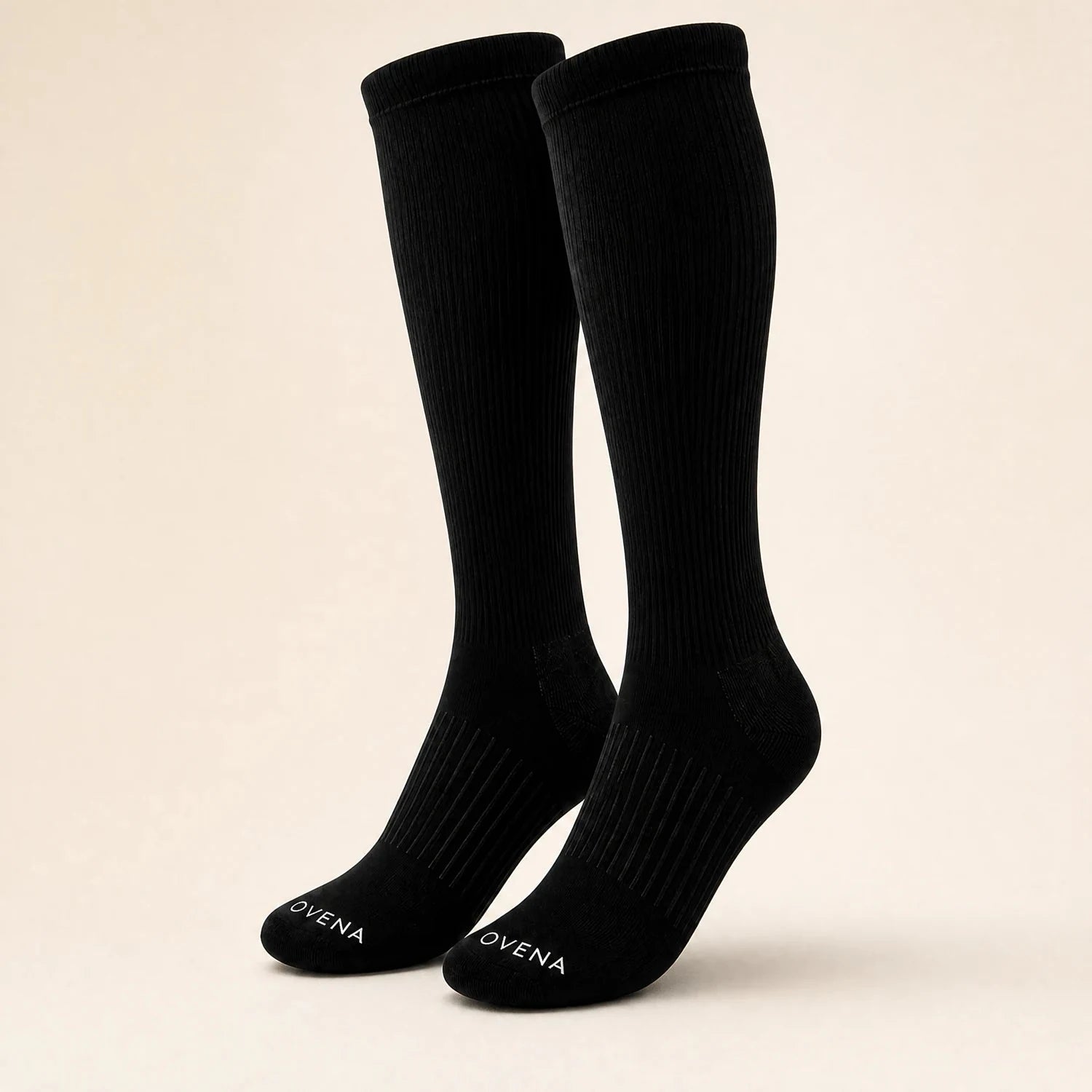
Medical compression socks: how 20-30 mmHg actually works
If a clinician has recommended compression, or you're weighing it for flying, pregnancy, varicose veins, or post-surgical recovery, start here. This clinician-reviewed guide covers what mmHg means, how to size correctly, how to wear the socks day to day, and how to keep them working.
 Medically reviewed byDavid Chahine, MD
In this guide
What does 20-30 mmHg mean?
mmHg stands for millimeters of mercury, the same unit your blood pressure is measured in. "20-30 mmHg" means the sock applies between 20 and 30 millimeters of mercury of pressure to your leg, with the firmest compression at the ankle and gradually less compression as the sock moves up toward the knee.
It is the moderate medical compression class, above the 15-20 mmHg "lifestyle compression" most consumer brands sell and a step below the 30-40 mmHg class used for severe venous disease and lymphedema. For long-distance travel, the American College of Chest Physicians suggests properly fitted, below-knee stockings providing 15-30 mmHg of pressure at the ankle for travelers who already have VTE risk factors, and suggests against them for travelers who do not (Grade 2C, a weak suggestion based on low-certainty evidence).(2) Ovena's 20-30 mmHg sits inside that range.
How graduated compression actually works
When you're standing or sitting still, gravity pulls blood and lymphatic fluid downward into your lower legs. Healthy leg veins have one-way valves that, combined with your calf muscle contractions, push the blood back up to your heart. When those valves are weak or damaged, blood pools, leading to swelling, aching, varicose veins, and in advanced disease, skin changes and venous leg ulcers.
Graduated compression replicates what a healthy calf muscle pump does. A 2021 Cochrane review pooled 12 randomized trials in 2,918 air travelers. In the nine trials that compared wearing stockings on both legs with wearing none, follow-up data were available for 2,637 people: symptomless DVT was found in 3 of those who wore graduated compression stockings and 47 of those who did not, an odds ratio of 0.10 (95% CI 0.04 to 0.25), rated high-certainty evidence. No symptomatic DVTs, pulmonary emboli, or deaths occurred in any of the included trials, so the review could not assess those outcomes.(1)
Compression sock levels explained
| Level | What it's for | Typical user |
|---|---|---|
| 8-15 mmHg | Mild support, all-day comfort | Office workers, mild leg fatigue |
| 15-20 mmHg | Mild medical, travel, mild varicose | Frequent travelers, mild pregnancy swelling |
| 20-30 mmHg | Moderate medical compression | CVI, varicose veins, post-surgical, nurses, travel-related DVT risk reduction |
| 30-40 mmHg | Strong medical compression | Severe venous disease, lymphedema |
| 40-50 mmHg | Maximum compression | Severe lymphedema, clinician-supervised |
Who should check with a clinician first
Compression at this level is not for everyone. Talk with a clinician before using 20-30 mmHg compression if you have:
- Peripheral arterial disease, or known poor circulation in the legs
- Decompensated heart failure
- Severe neuropathy or reduced sensation in the feet
- A skin infection over the area you would cover
- An untreated or suspected DVT
New, sudden, or one-sided leg swelling should be evaluated by a clinician before you use compression. Stop use and contact your clinician if you notice numbness, tingling, discoloration, or increased pain.
How to size compression socks correctly
Sock size in compression is not based on shoe size. The two measurements that matter are:
- Ankle circumference — the smallest part, just above the bony bump.
- Calf circumference — the widest part.
Measure first thing in the morning, before you have been standing — that is when your leg is at its smallest. Size from your ankle measurement, because the ankle is where the 20-30 mmHg is delivered. If your calf falls outside the range for that size, choose a wide-calf garment rather than moving up or down a size (Ovena does not currently offer a wide-calf style; email info@ovenahealth.com and we will help you find the right fit): sizing down pushes the pressure above the class you were told to wear, and sizing up drops it below. If your measurements land on the boundary between two sizes, size by your ankle. See Ovena's compression sizing chart →
How to put compression socks on
- First thing in the morning, before standing up.
- Turn the sock inside out down to the heel. Place your foot in the heel pocket.
- Roll the sock up your leg, smoothing wrinkles as you go.
- Check the heel position and make sure the top isn't folded over.
If arthritis, limited mobility, or recent surgery makes bending to your feet hard, a long-handle sock aid — a curved plastic channel with pull cords — is designed to make donning easier.
Common uses
Long flights and travel
For travelers who already carry VTE risk factors, the American College of Chest Physicians suggests below-knee 15-30 mmHg stockings during travel (a weak, low-certainty recommendation), and suggests against them for everyone else.(2)
Nurses and 12-hour shifts
A 12-hour shift is hours of standing with little of the calf-muscle pumping that moves blood back up the leg. Compression at this level is commonly worn to ease end-of-day swelling and leg fatigue.
Pregnancy
Commonly used in the second and third trimesters for swelling and varicose vein discomfort. Confirm with your OB-GYN before starting. New, sudden, or one-sided leg swelling should be evaluated by a clinician before you use compression.
Tired, achy legs at end of day
Many people notice less aching and heaviness within the first week of wearing them through the day.
How to wash compression socks so they last
How you wash compression socks affects how long they hold their compression. Standard laundry detergent is alkaline (pH 9-10), which drives hydrolysis of the polyurethane bonds in spandex and elastane.
- Use a mild, pH-balanced wash (pH 5-7) — never standard detergent.
- Hand wash or delicate cycle in cool water.
- Don't use fabric softener — it coats the fibers.
- Don't put them in the dryer on heat. Air dry flat.
- Wash after every wear if you can.
FAQs
Can I sleep in compression socks?
What if I feel numbness or my toes change color?
Are they FSA/HSA eligible?
Sources
- Clarke MJ, Broderick C, Hopewell S, Juszczak E, Eisinga A. Compression stockings for preventing deep vein thrombosis in airline passengers. Cochrane Database of Systematic Reviews 2021, Issue 4. Art. No.: CD004002. https://doi.org/10.1002/14651858.CD004002.pub4
- Kahn SR, Lim W, Dunn AS, et al. Prevention of VTE in Nonsurgical Patients: Antithrombotic Therapy and Prevention of Thrombosis, 9th ed: American College of Chest Physicians Evidence-Based Clinical Practice Guidelines. Chest. 2012;141(2 Suppl):e195S-e226S. https://doi.org/10.1378/chest.11-2296