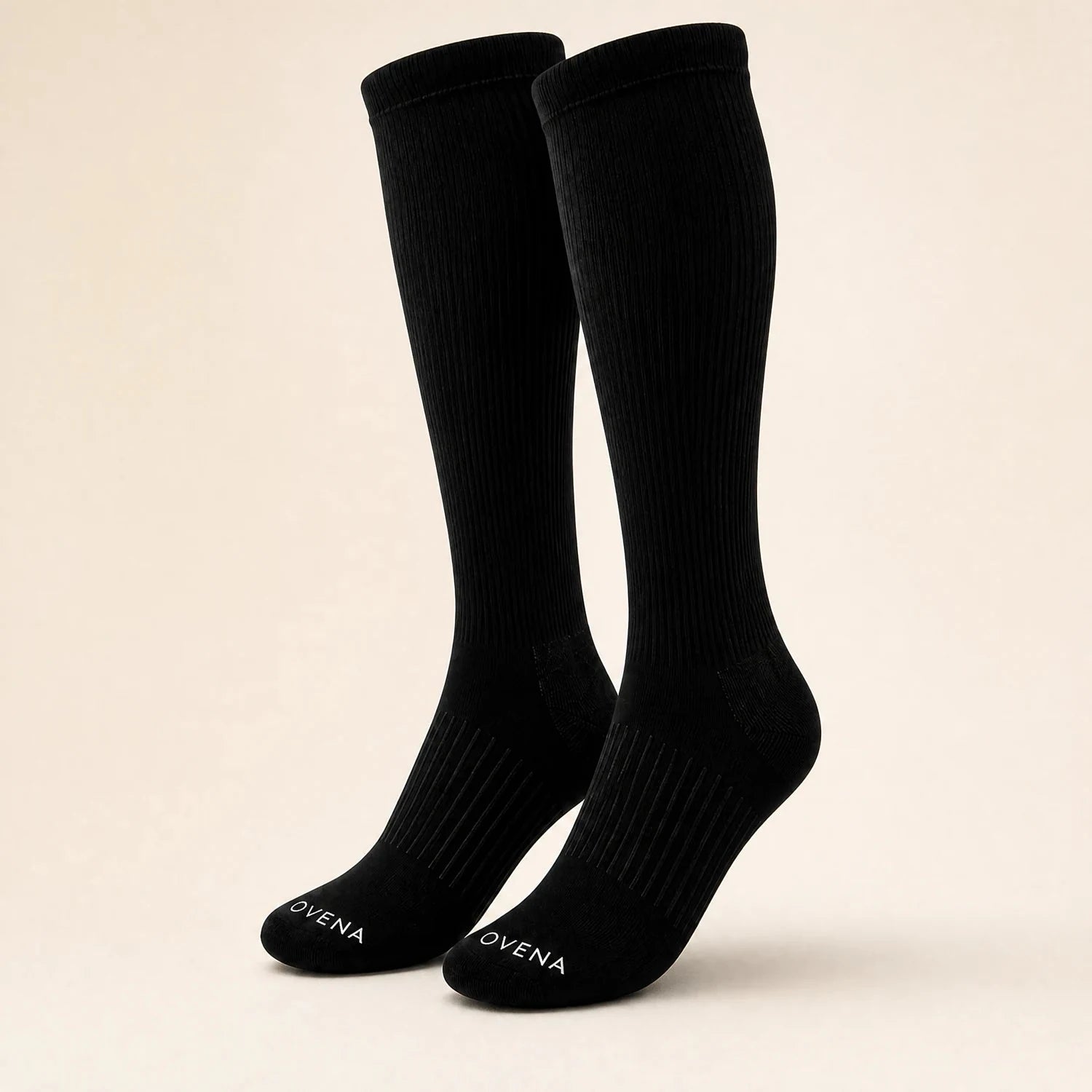
Copper Fit vs medical compression socks
The difference between consumer compression sleeves and medical-grade graduated compression socks, including when 20-30 mmHg support matters.
 Reviewed byDavid Chahine, MD
In this comparison
Copper Fit (and competitors like Tommie Copper) market copper-infused fabric as performance apparel — "compression" and "recovery" and "copper benefits." If your doctor told you to get medical compression and you bought Copper Fit, this guide is for you. The two are sold on different terms. Medical graduated compression is sold at a stated pressure class, measured at the ankle; copper support apparel is sold on fit and feel, with no mmHg number attached. Both have a place, and they don't substitute for each other.
Side-by-side comparison
| Ovena | Copper Fit / Tommie Copper / copper-infused support apparel | |
|---|---|---|
| Labeled compression class | 20-30 mmHg graduated, stated at the ankle | No mmHg class published. Compression is described qualitatively — "light to medium," "moderate to strong" — and several sock styles are marketed as graduated (2) |
| Category | Graduated compression hosiery, sold and sized to a stated pressure class | Support and performance apparel, sold on fit and feel |
| Commonly worn for | Long shifts on your feet, long flights, pregnancy, recovery after surgery, varicose vein discomfort | General support during activity, everyday aches, warmth |
| Evidence for the category | Graduated compression at a stated class: on flights, a 2021 Cochrane review of 12 randomized trials in 2,918 air travelers — evidence for the class, not for any one brand (1) | Randomized trials of copper-impregnated fabric exist, but they test other outcomes (3) |
| Sizing | Measured from ankle and calf circumference | General apparel sizing |
| Price (single pair) | $24.99 | Compression socks $19.99-$29.99 on the brand's own store (2) |
| FSA / HSA | Commonly eligible; your plan administrator decides, and a Letter of Medical Necessity may be required | Typically not; ask your plan administrator before you count on it |
The marketing vs the product
Copper Fit's marketing rests on two pillars: compression and copper. Both are worth looking at honestly, because one of them is a smaller difference than people assume and the other is a bigger one.
On compression. Copper Fit does sell socks it describes as graduated compression, so the common shorthand that it is "not real compression" overstates the case. The difference that matters is narrower and more practical: no Copper Fit product publishes an mmHg class. Across all 53 products listed on the brand's own store, the compression is described in words — "light to medium," "moderate to strong," "mild to moderate" — and the letters mmHg appear on none of them (2). When a clinician tells you to wear 20-30 mmHg, that number is the instruction, and a garment that doesn't state a number can't be matched to it. That is the whole of the compression difference: not that the fabric is inert, but that you cannot tell what class you are wearing.
On copper. The claimed mechanism is copper transferring from fabric to skin for anti-inflammatory or antimicrobial effects. Randomized trials of copper-impregnated fabric do exist, but they test other things — skin elasticity in healthy volunteers, hospital infection rates in ventilator-dependent patients, and one small stocking trial in venous skin disease — and several were run by a copper-fabric manufacturer (3). We found no randomized trial showing that copper-infused athletic wear relieves joint pain or speeds recovery. The one randomized trial of copper for joint pain used a bracelet rather than a textile, and it found no benefit over placebo (4). The FTC has separately brought an enforcement action against a competing copper-apparel brand over unsupported health claims (FTC v. Tommie Copper). Treat the copper story as marketing until a trial tests what the marketing claims.
When Copper Fit is fine to wear
If you bought Copper Fit and you like how it feels — general support during a workout, mild comfort, or simply because you find the fabric pleasant — keep wearing it. It just isn't the thing your clinician specified when they named a compression class. One caveat either way: the circulation cautions further down this page apply to any snug garment on your legs, not only to a labeled medical class.
When you need medical compression
- You're a nurse on a 12-hour shift — your ankles swell and your legs ache by the end of it. That is what a stated 20-30 mmHg graduated class is for.
- You're flying long-haul. The Cochrane evidence on air travel comes from trials that used stockings at a stated class — four trials at 20-30 mmHg and five at 10-20 mmHg — so matching it means wearing a garment that names its class (1).
- You're post-surgical and the discharge instructions say to wear compression. They mean a stated class. Follow the class and the duration your surgeon gave you.
- Your clinician diagnosed venous insufficiency or varicose veins and prescribed a class. Buy to the class, not to the marketing.
- You have a history of DVT or a known clotting disorder. Compression choices in that situation belong with your clinician, not with a shopping guide.
How to tell medical compression from support apparel
The tell is a number. Medical graduated compression states its ankle pressure explicitly — "20-30 mmHg knee-high" means 20-30 mmHg at the ankle, easing as the garment goes up the calf. Support apparel is usually sold in general apparel sizes and described qualitatively, with no class stated anywhere on the package or the product page.
The second tell is how you're asked to size it. Graduated compression is sized from measurements, because the class is delivered at the ankle. Measure the smallest point just above the ankle bone first thing in the morning, before any swelling has set in, and match it to the ankle band on the size chart; then check your calf at its widest point against the same size's calf range. If your measurements land on a boundary between two bands, size by your ankle. If your calf falls outside the range for the size your ankle picked, choose a wide-calf garment — Ovena doesn't currently offer one, so you'll need to shop a brand that does. Sizing up or down to make the calf fit changes the pressure the garment delivers at the ankle, which is the one thing you were trying to control.
Before you start compression
Graduated compression isn't right for everyone, and the reason is circulation. Talk to a clinician before wearing 20-30 mmHg — or any compression class — if you have:
- peripheral arterial disease, or leg pain when you walk that eases when you rest;
- decompensated heart failure;
- severe neuropathy or reduced sensation in your feet;
- a skin infection over the area the garment would cover;
- an untreated or suspected DVT.
New, sudden, or one-sided leg swelling is a reason to see a clinician before you put compression on, not a reason to put it on.
Frequently asked questions
Does Copper Fit do anything?
Is the copper claim real?
Can I wear Copper Fit on a flight instead of medical compression?
If I'm a nurse, should I wear Copper Fit?
Shop Ovena 20-30 mmHg Compression Socks →
$24.99 / pair · knee-high, closed-toe, S-XL · commonly FSA/HSA eligible
Shop Ovena 20-30 mmHg Compression Socks →Sources
- Clarke MJ, Broderick C, Hopewell S, Juszczak E, Eisinga A. Compression stockings for preventing deep vein thrombosis in airline passengers. Cochrane Database Syst Rev. 2021;4(4):CD004002. https://doi.org/10.1002/14651858.CD004002.pub4 (12 trials, n = 2,918. Of the nine below-knee trials, four used 20-30 mmHg at the ankle and five used 10-20 mmHg. No included trial recorded a symptomatic DVT, a pulmonary embolism, or a death.)
- Copper Fit product catalog and product pages read August 20, 2026 (copperfitusa.com, 53 products): compression described qualitatively, no mmHg class stated on any product; socks marketed as graduated compression priced $19.99-$29.99.
- Arendsen LP, Vig S, Thakar R, Sultan AH. Impact of copper compression stockings on venous insufficiency and lipodermatosclerosis. Phlebology. 2019;34(4):224-230. (Double-blind randomized controlled pilot, 16 patients; no significant difference in mean symptom scores.) See also Dykes P. Skin Res Technol. 2015;21(3):272-277 (skin elasticity) and Marcus EL, et al. Am J Infect Control. 2017;45(4):401-403 (hospital infection indicators); several copper-textile trials list authors affiliated with a copper-fabric manufacturer.
- Richmond SJ, Gunadasa S, Bland M, Macpherson H. Copper bracelets and magnetic wrist straps for rheumatoid arthritis. PLoS One. 2013;8(9):e71529. (Randomized, double-blind, placebo-controlled crossover trial; n = 70; no significant difference on pain, inflammation, physical function, disease activity, or medication use.)
Our collagen dressings and powder are FDA 510(k)-cleared. Ovena compression socks are general-use graduated compression hosiery and are not a cleared device.