How often should you change a collagen dressing?
The 1–3 day standard, when to change more often, when to change less often, and the signs you have the cadence wrong.
 Reviewed byDavid Chahine, MD
In this guide
The short answer
Change a collagen wound dressing every 2-3 days for most wounds. More often — as often as daily — if the wound is producing a lot of drainage; toward the 3-day end if it's relatively dry. The secondary cover dressing may need changing more often if it saturates, but the collagen itself can often stay in place across multiple secondary changes. Follow the instructions for use that come with your dressing, and follow your clinician's schedule where it differs.
Why frequency matters
Two things are working when a collagen dressing is on a wound:
- Matrix metalloproteinase (MMP) binding. The collagen is being consumed by the wound's elevated enzymes. This takes hours to days. (See our MMP explainer for the biochemistry.)
- Scaffolding for new tissue. Fibroblasts and capillaries are attaching to the collagen matrix and growing through it. Disturbing the dressing physically disrupts this fragile new tissue.
Change too often and you interrupt both processes. Change too rarely and the dressing is fully consumed before it can keep doing its job, plus the wound bed risks bacterial overgrowth in a saturated environment. The 2-3 day window balances both.
The standard 2-3 day schedule
Most wound care protocols default to every 2 days as the baseline. From there, adjust based on the wound's specific behavior.
A reasonable starting cadence by wound type:
- Diabetic foot ulcer: every 1-2 days (higher drainage, higher infection vigilance)
- Pressure injury, stage 2: every 2-3 days
- Pressure injury, stage 3-4: every 1-2 days (typically more drainage)
- Post-Mohs site: every 2-3 days (low drainage)
- Surgical wound healing open: every 1-2 days (variable drainage)
- Donor site: every 2-3 days
- Venous leg ulcer: every 1-2 days under compression bandaging
When to change MORE often (closer to every 24 hours)
- Heavy drainage that saturates the secondary dressing. If you'd typically change at 48 hours but the secondary is fully wet by 12 hours, your wound needs more absorbency, or a different dressing strategy. Talk to your clinician about adding a foam secondary or upgrading from collagen sheet to powder.
- Suspected mild infection. Increased exudate, slight odor, mild surrounding redness. Increased frequency lets you inspect the wound more often and catch worsening. (If there is confirmed infection — fever, spreading redness, or foul discharge — see when to call a clinician.)
- The wound is in a high-friction or high-movement area (elbow, knee, foot in a shoe). Dressings shift and lift more often.
When to change LESS often (toward every 3 days)
- Low-drainage wound with intact secondary dressing. If the secondary is still dry and well-adhered at the 48-hour mark, you can usually go to 72 hours.
- Quiet, healing wound in proliferation phase. Once the wound is closing and granulation tissue is filling in nicely, longer intervals avoid disturbing the new tissue.
- Donor sites or post-Mohs sites without complications. These low-drainage sites are well-suited to the longer end of the window.
Every 2-3 days is the typical interval, and the collagen primary should not stay on beyond 7 days without your clinician's direction. Follow the instructions for use packaged with your dressing; a longer interval than that is a clinician's call, not a default.
Signs you've got the cadence wrong
Signs you're changing too often
- Granulation tissue looks chronically friable (bleeds at every change)
- Healing has plateaued despite consistent technique
- You're burning through dressings — typical use is 2-3 per week per wound
Signs you're not changing often enough
- Secondary dressing is saturated and possibly leaking
- The collagen has fully gelled and pooled, meaning it was consumed earlier in the interval
- Odor at change time. Some smell from a gelled dressing is expected, but a foul or worsening odor is not — treat it as a possible sign of infection and contact your clinician
- Surrounding skin shows maceration (white, soft, soggy skin around the wound edge) — too much moisture sitting too long
Cost implications
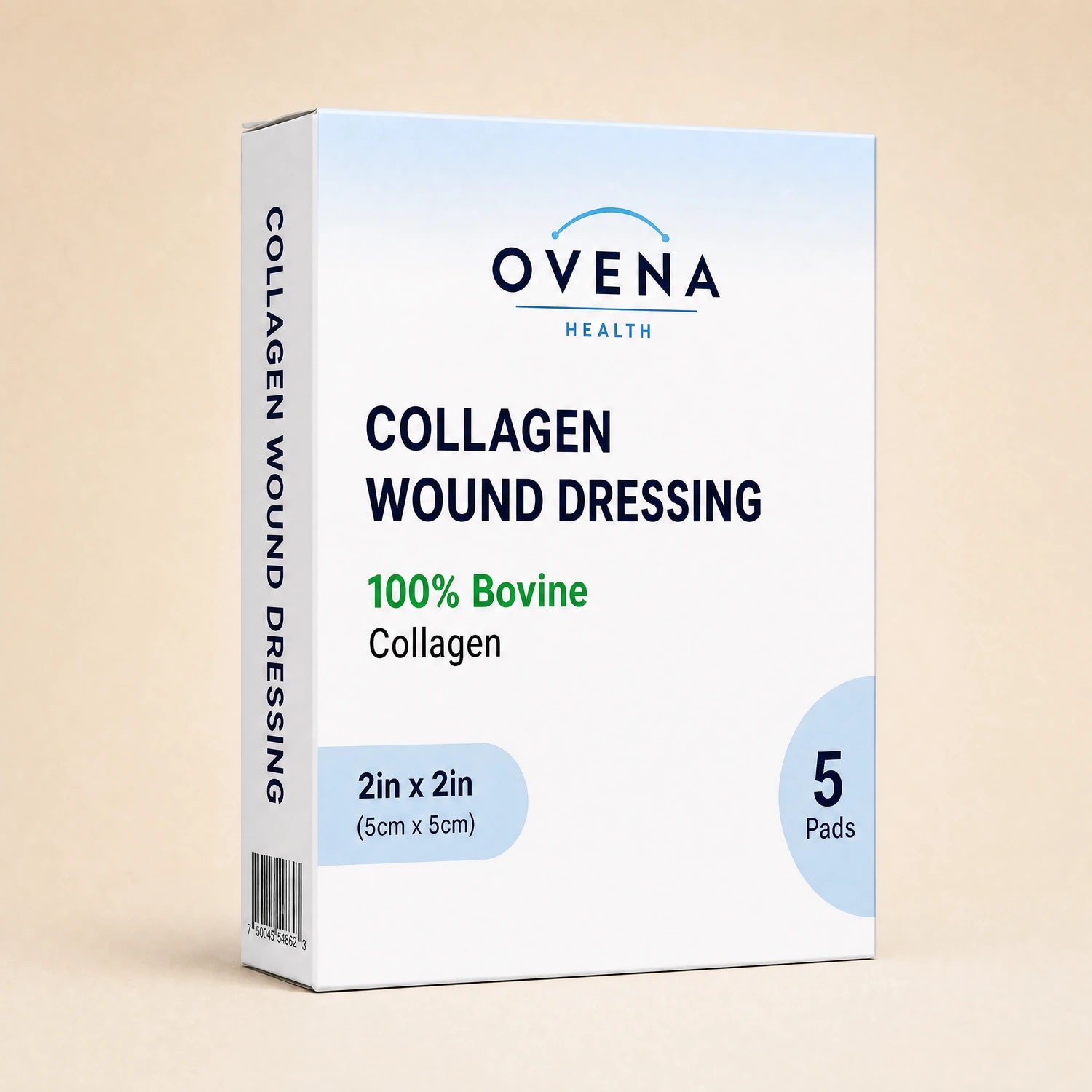
This isn't trivial — collagen dressings cost money. At 2-3 dressings per week, a single Ovena 5-pack of 4x4 dressings ($52.99) lasts about 12-17 days. At one dressing per day, the same pack lasts 5 days.
Changing daily when every-other-day would do roughly doubles your collagen cost. Over a 12-week course, every-other-day comes to about 42 dressings, or ~$445 at the 4x4 5-pack price; daily comes to about 84 dressings, or ~$890. Most patients err on the side of changing too often. Don't.
If you're regularly going through more than 4 dressings a week, that's either a wound that needs a different strategy (different dressing type, clinician consultation), or a cadence that's too aggressive.
Stock the right amount
For a typical chronic wound at the 2-3 day cadence, plan for one Ovena 5-pack every ~2 weeks.
Shop collagen wound dressings →Frequently asked questions
Why not change it every day?
My secondary dressing is wet, do I need to change the collagen too?
Should I change more often for a diabetic foot ulcer?
What if I forget and a dressing stays on for 4-5 days?
Sources
- Brett DW. A Review of Collagen and Collagen-Based Wound Dressings. Wounds. 2008;20(12):347-356.
- WOCN Society. Guideline for the Prevention and Management of Pressure Ulcers (Injuries). 2016.
- European Wound Management Association (EWMA). Position Document: Identifying criteria for wound infection. London: MEP Ltd, 2005.