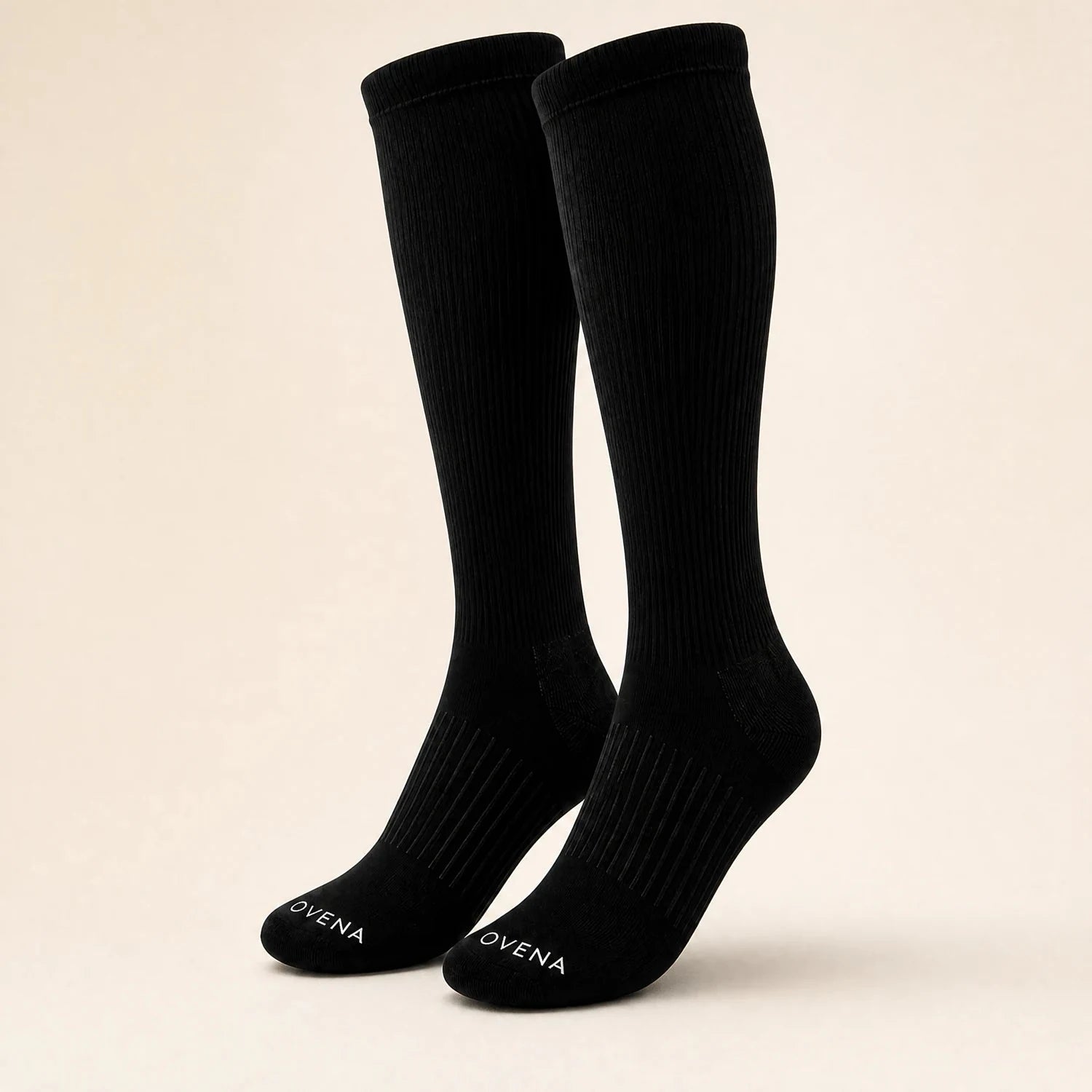
Ovena vs Jobst compression socks
A practical comparison of Ovena and Jobst compression socks, including compression level, comfort, sizing, daily wear, and value for home and clinical use.
 Reviewed byDavid Chahine, MD
In this comparison
Jobst is the legacy name in medical compression — the brand wound care nurses, vascular surgeons, and vein clinics reach for first. If your doctor said "get a pair of 20-30 mmHg Jobst," you're being told to get real graduated compression, not a lifestyle sock. The Ovena knee-high is labeled at the same 20-30 mmHg graduated class and is made for the same everyday reasons people are told to wear it: long shifts on your feet, long flights, pregnancy, recovery after surgery, and varicose vein discomfort — at retail-direct pricing.
Side-by-side comparison
| Ovena | Jobst Relief | |
|---|---|---|
| Labeled compression class | 20-30 mmHg graduated | 20-30 mmHg graduated |
| Style | Knee-high, closed-toe, S-XL — one style | Knee-high, thigh-high, open-toe, and more |
| Commonly worn for | Long flights, long shifts on your feet, pregnancy, recovery after surgery, varicose vein discomfort | The same everyday reasons, plus the styles and classes Ovena doesn't make |
| Fiber | Nylon, spandex, and a moisture-wicking blend | Nylon and spandex blend |
| FSA / HSA | Commonly eligible; your plan administrator decides, and a Letter of Medical Necessity may be required | Commonly eligible; same plan rules apply |
| Price (single pair) | $24.99 | $46-58 at compression retailers, about $36 on Amazon (2) |
| Replace when | The fabric stops springing back and the sock no longer feels firm | Same. Wash either brand in a mild, pH-balanced detergent — alkaline laundry detergent is what degrades elastane |
| Where to buy | ovenahealth.com, Amazon | Medical supply stores, some pharmacies, Amazon |
What's the same
Both Jobst Relief and Ovena are sold as graduated compression labeled 20-30 mmHg. Graduated means the pressure is highest at the ankle and eases as the sock goes up the calf, which is the profile designed to help venous blood move back toward the heart against gravity. That is a labeling class rather than a guarantee that two garments deliver identical pressure on your leg, and we don't publish third-party pressure test data for either product. (For the underlying science, see our compression-for-nurses guide.)
People wear either brand for the same everyday reasons: long shifts on your feet, long flights, pregnancy swelling, recovery after surgery, and varicose vein discomfort. On flights specifically, a 2021 Cochrane review pooled 12 randomized trials in 2,918 air travelers. In the nine trials that compared stockings on both legs against none and had follow-up data for 2,637 participants, a symptomless DVT was found in 3 people who wore stockings and 47 who did not — odds ratio 0.10, 95% CI 0.04 to 0.25 (1). No included trial recorded a symptomatic DVT, a pulmonary embolism, or a death, so the review cannot speak to those outcomes, and every flight studied lasted more than five hours. Both brands are commonly FSA/HSA eligible; your plan administrator decides, and a Letter of Medical Necessity may be required.
The real difference: brand premium and distribution
Jobst has been the brand since 1950 and is owned by Essity, a multinational hygiene and health company. The brand is what hospitals stock, what medical supply stores recommend, and what patients have heard their doctor mention. The premium pricing reflects both real R&D and brand momentum.
Ovena sells direct. We don't have a sales force calling on vascular surgery clinics. We make a knee-high garment labeled at the same 20-30 mmHg graduated class, on a USA-based manufacturing line, and ship it to your door for $24.99. On the day we checked, a Jobst Relief 20-30 mmHg knee-high ran $46-58 at compression retailers and about $36 on Amazon (2). Both brands run frequent sales, so check current pricing before you decide.
When Jobst IS the right choice
- Your fitter at a medical supply store recommends Jobst and you trust their measurement work. Buying from a fitted shop is genuinely valuable — they get your size right.
- You need a style Ovena doesn't stock — thigh-high, pantyhose, open-toe, wide-calf, or custom-fit. Jobst has a much wider catalog.
- You have a Jobst pair that fits perfectly and don't want to disrupt that.
When Ovena is the better fit
- You're a nurse buying daily wear out of your own pocket and want to stretch the budget to two or three pairs in rotation rather than one Jobst pair.
- You're shopping for travel. A single pair for one trip is $24.99, against $46-58 at compression retailers for the equivalent Jobst Relief pair.
- You're recovering from surgery and need compression for weeks rather than days; the pair-count math gets harsh at legacy-brand pricing. Follow the duration your surgeon gives you.
- You'd rather order online than make a trip to a medical supply store. We sell direct at ovenahealth.com and stock the socks on Amazon; delivery speed depends on the shipping option you choose at checkout.
How to know you're getting the right fit
Size from your ankle. The compression class is delivered at the ankle, so that is the measurement the size is built around. Measure the smallest point just above the ankle bone, first thing in the morning before any swelling has set in, and match it to the ankle band on the size chart. Then measure your calf at its widest point and check it against the same size's calf range.
If your measurements land on a boundary between two bands, size by your ankle. If your calf falls outside the range for the size your ankle picked, choose a wide-calf garment — Ovena doesn't currently offer one, and Jobst offers wide-calf lines built for exactly that. Don't size up or size down to make the calf fit, because either move changes the pressure the sock delivers at the ankle.
A Jobst size that was fitted for you doesn't automatically carry across. Measure again against Ovena's chart rather than assuming the letter size transfers between brands. For step-by-step sizing, see our compression-for-nurses sizing section.
Before you start compression
Graduated compression isn't right for everyone, and the reason is circulation. Talk to a clinician before wearing 20-30 mmHg — or any compression class — if you have:
- peripheral arterial disease, or leg pain when you walk that eases when you rest;
- decompensated heart failure;
- severe neuropathy or reduced sensation in your feet;
- a skin infection over the area the sock would cover;
- an untreated or suspected DVT.
New, sudden, or one-sided leg swelling is a reason to see a clinician before you put compression on, not a reason to put it on.
Frequently asked questions
Is the Ovena sock the same compression class as Jobst Relief 20-30?
Will I notice a difference in fit?
Are Ovena socks just as durable?
Will my doctor accept Ovena for medical recommendations?
Shop Ovena 20-30 mmHg Compression Socks →
$24.99 / pair · knee-high, closed-toe, S-XL · commonly FSA/HSA eligible
Shop Ovena 20-30 mmHg Compression Socks →Sources
- Clarke MJ, Broderick C, Hopewell S, Juszczak E, Eisinga A. Compression stockings for preventing deep vein thrombosis in airline passengers. Cochrane Database Syst Rev. 2021;4(4):CD004002. https://doi.org/10.1002/14651858.CD004002.pub4 (12 trials, n = 2,918; the 3-vs-47 symptomless-DVT result comes from the nine both-legs trials with follow-up data for 2,637 participants.)
- Jobst Relief 20-30 mmHg knee-high prices read August 20, 2026: jobststockings.com $46.40 sale / $58.00 list, operated by Aleva Stores, LLC as an authorized retailer; Amazon $36.00. Compression retailers run near-constant sale pricing, so these are a spot check rather than a standing figure.
Our collagen dressings and powder are FDA 510(k)-cleared. Ovena compression socks are general-use graduated compression hosiery and are not a cleared device.