Medline Puracol alternative, what's actually different
 Reviewed byDavid Chahine, MD
In this comparison
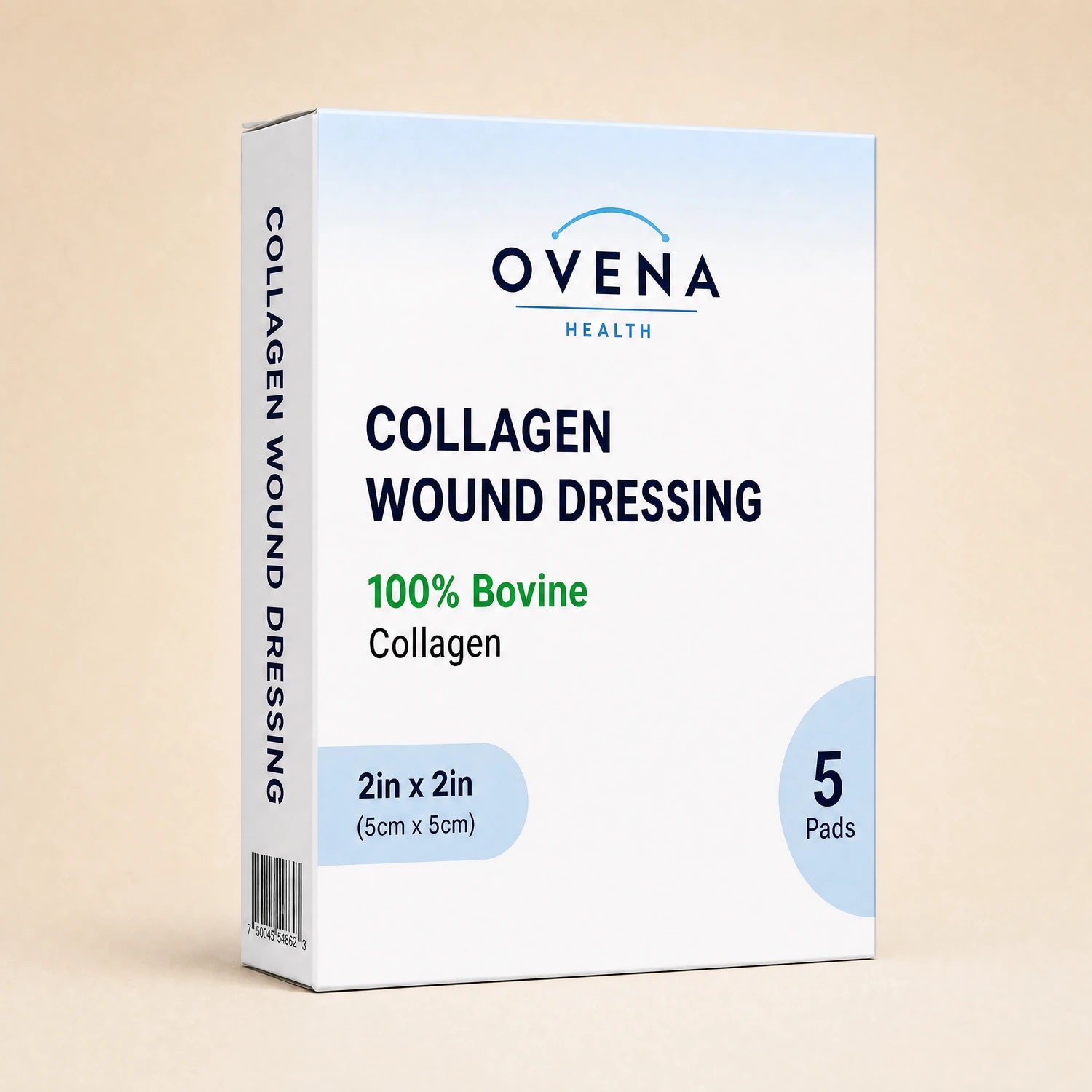
If you've been told to use Puracol — by a wound clinic, a discharge nurse, or your own research — you've already done the hard part: you've identified that you need a real collagen wound dressing rather than just a bandage. Puracol is a legitimate FDA 510(k)-cleared collagen dressing made by Medline. Ovena's Collagen Wound Dressing is a separately cleared collagen dressing in the same product category, with one practical difference: you can buy it retail-direct, without a hospital supply chain relationship.
Side-by-side comparison
| Ovena | Medline Puracol | |
|---|---|---|
| Regulatory status | FDA 510(k)-cleared collagen wound dressing | FDA 510(k)-cleared collagen wound dressing, under its own separate clearance |
| Form | Sterile sheet, purified Type I bovine collagen, plus a collagen powder | Collagen dressing; check the labeling supplied with the product you were given |
| Cleared indications | As stated in Ovena's labeling — follow the instructions supplied with the product | As stated in Medline's labeling. The two products were cleared separately, so the labeling is not interchangeable |
| Sizes | 2x2 and 4x4 sheets, plus collagen powder | Multiple sizes; see Medline's catalog |
| HCPCS coding | A6021 for both sheet sizes; A6010 for the powder | Collagen sheets are coded by size rather than by brand, so the code follows the sheet you use. The larger tiers cover sheets Ovena does not sell |
| FSA / HSA | Commonly eligible; your plan administrator decides, and a Letter of Medical Necessity may be required | Commonly eligible; the same plan rules apply |
| Made in | USA, ISO 13485 facility | See Medline's product information |
| Pricing | 2x2 5-pack $25.99 ($5.20 per dressing); 4x4 5-pack $52.99 ($10.60 per dressing) | Sold through medical supply distributors, where pricing depends on the account and is generally not published as consumer retail |
| Where to buy | ovenahealth.com, Amazon | Medical supply distributors, hospital and clinic supply channels |
What's the same (and it matters)
Both are collagen wound dressings that cleared the FDA's 510(k) pathway. That is the part worth holding on to if you are standing in front of a shelf: you are not choosing between a medical device and a home remedy — you are choosing between two cleared products in the same category. Each was cleared on its own submission, though, so their labeling is their own. Read the instructions that ship with whichever product you use, and don't assume a claim you read about one applies to the other.
Both work on the same general principle. A chronic wound bed carries elevated protease activity, and a collagen dressing gives those enzymes a sacrificial substrate to act on. The published mechanism work is an ex vivo study: wound fluid from people with diabetic foot ulcers was exposed to a collagen and oxidized regenerated cellulose (ORC) matrix, which bound and inactivated proteases, significantly reducing neutrophil elastase, plasmin, and matrix metalloproteinase activity compared with wet gauze (2). Note what that study is and isn't: it measures enzyme activity in a dish rather than wounds closing in people, it was run by the manufacturer of the dressing it tested, and it tested a collagen/ORC matrix specifically. It describes a mechanism. It is not a healing result. (For the biochemistry, see our MMP explainer.)
The real difference: distribution
Medline is one of the largest medical supply distributors in the United States, and it serves hospitals, wound care clinics, skilled nursing facilities, and home health agencies. Its products are most easily obtained through a clinical relationship — a nurse orders a box, the clinic uses it on you, and you get a bill.
Ovena is built for the moment after the clinical relationship ends: the caregiver continuing care at home, the patient managing a wound with their podiatrist's supervision, the family member changing dressings for a parent. We sell direct at ovenahealth.com and stock the dressings on Amazon, and delivery speed depends on the shipping option you choose at checkout. The distribution path is the difference; it is not a claim that one product outperforms the other.
When Puracol IS the right choice
We'll tell you straight. If you're already in a wound clinic that stocks Puracol and your insurance is covering the dressings, keep using Puracol. Don't introduce variables — it's a cleared product your clinic already knows how to use, and switching mid-course for no reason adds risk without adding anything.
The same goes if you're a clinician building protocols for a skilled nursing facility or a hospice and Medline is your existing group purchasing contract. Puracol is the path of least friction there, and we respect that.
When Ovena is the better fit
- You're managing care at home. The hospital sent you home, the discharge instructions say "collagen dressing," and you don't have a Medline rep. We sell direct and on Amazon.
- Your plan won't cover the brand your clinic used. Collagen sheet dressings are reimbursed by HCPCS code and size rather than by brand, so a plan that declines one product may still reimburse another under A6021. Ask your plan what it needs; we provide an itemized receipt with the applicable code on request.
- You want a pack size that matches home use. Ovena sells 5-packs — $25.99 for five 2x2 dressings and $52.99 for five 4x4 dressings, which works out to $5.20 and $10.60 per dressing. Distributor pack counts are built for clinics that go through them faster than a household does.
- You want the reasoning written down. Every piece of educational content on this site carries a named clinical reviewer and a source list you can check.
What the evidence shows
Here is the honest version, which is more measured than most marketing copy on this category. The most-cited trial is Veves et al. 2002, which randomized 276 people with diabetic foot ulcers to Promogran (a collagen/ORC dressing) or moistened gauze and followed them for up to 12 weeks. Complete closure came in at 37.0% with the collagen/ORC dressing vs 28.3% with gauze — a difference that did not reach statistical significance (P = .12) — and the authors' own conclusion was that Promogran was comparable to moistened gauze. The one place a signal appeared was in ulcers open less than six months: 45% healed vs 33%, at P = .056, which the paper itself calls borderline (1).
Guidance is correspondingly cautious. The WOCN Society's clinical resource guide, listing options for wounds due to diabetes or neuropathic disease, says to "[c]onsider use of collagen or hyaluronic acid dressings that might promote healing" (3). Read that wording closely: consider, might, and collagen offered interchangeably with hyaluronic acid. It is an option a clinician may choose, not an instruction to use collagen. Other guideline bodies weigh the same evidence differently, so treat the choice as a conversation with your wound clinician rather than something to settle from an article.
What that means for this comparison is simple, and it cuts against the usual brand-versus-brand framing. There are no head-to-head trials between specific 510(k)-cleared collagen brands, so nobody — us included — can tell you that one collagen dressing outperforms another. What you can reasonably compare is what you're able to get, what it costs you, and whether it fits the plan your clinician set.
Before you use a collagen dressing
Do not use collagen dressings if you are allergic to bovine (beef-derived) products. Ovena collagen is purified Type I bovine collagen. If the wound or the skin around it itches, burns, or breaks out in a rash after a dressing goes on, remove the dressing, rinse the area with saline, and contact your clinician. That is not a normal part of the dressing working.
A collagen dressing is also not the right answer to every stalled wound. A wound that has been open longer than four weeks needs a clinician's assessment — circulation, infection, and a biopsy if one is indicated. Collagen can be part of the plan your clinician sets; it isn't a substitute for the assessment. And if you have diabetes, peripheral arterial disease, or a weakened immune system, treat fever, spreading redness, or a sudden increase in drainage as an emergency — go to an emergency department the same day rather than urgent care or the next available appointment.
Frequently asked questions
Is Ovena Collagen Wound Dressing the same FDA classification as Puracol?
Can I switch from Puracol to Ovena mid-treatment?
Will my insurance reimburse Ovena?
Why is Ovena less expensive?
Do you have a collagen dressing larger than 4x4?
Shop Ovena Collagen Wound Dressing →
2x2 5-pack $25.99 · 4x4 5-pack $52.99 · FDA 510(k)-cleared · HCPCS A6021
Shop Ovena Collagen Wound Dressing →Sources
- Veves A, Sheehan P, Pham HT. A randomized, controlled trial of Promogran (a collagen/oxidized regenerated cellulose dressing) vs standard treatment in the management of diabetic foot ulcers. Arch Surg. 2002;137(7):822-827. (n = 276; complete closure 37.0% vs 28.3%, P = .12, not statistically significant.)
- Cullen B, Smith R, McCulloch E, Silcock D, Morrison L. Mechanism of action of PROMOGRAN, a protease modulating matrix, for the treatment of diabetic foot ulcers. Wound Repair Regen. 2002;10(1):16-25. (Ex vivo wound-fluid model of a collagen/ORC matrix; authors were with Johnson & Johnson Advanced Wound Care, the manufacturer.)
- WOCN Society. Lower-Extremity Wounds Due to Venous Disease, Arterial Disease, or Diabetes Mellitus and/or Neuropathic Disease: Clinical Resource Guide. Revised December 2021, "Topical Therapy: Considerations/Options" table.
Our collagen dressings and powder are FDA 510(k)-cleared. Ovena is not affiliated with Medline Industries, and Puracol is Medline's trademark.